

Narita International Airport (NRT) is Tokyo’s go-to airport for intercontinental flights. The airport is the busiest in Japan by international passenger traffic, but second in domestic and overall passengers after Tokyo’s primary airport, Haneda (HND).
Narita is located around 60 km east of central Tokyo in the Chiba Prefecture. It handled over 40 million passengers in 2024, rebounding well over the pre-pandemic numbers.
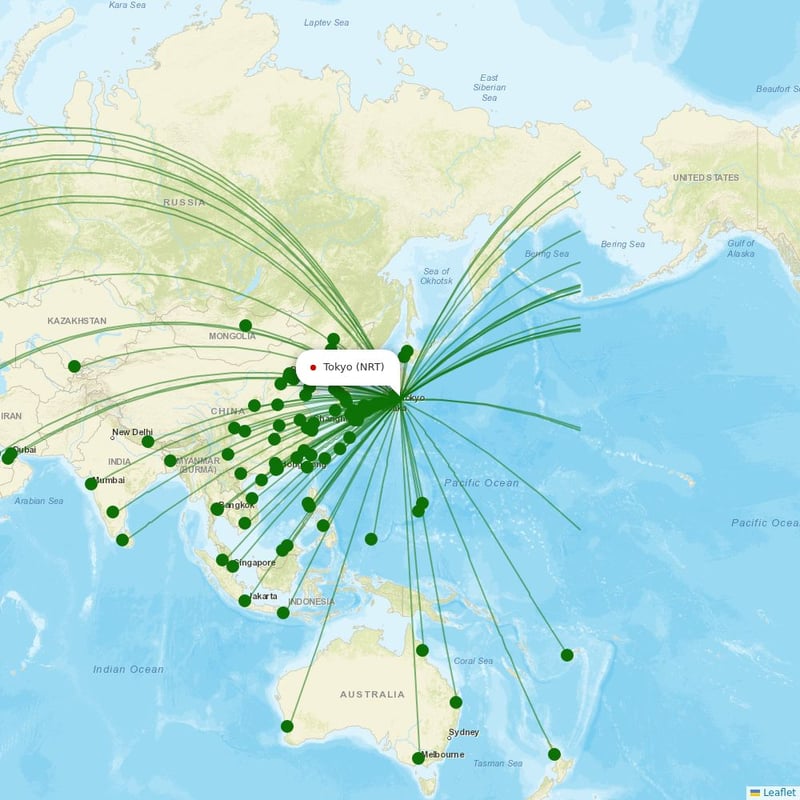
The airport offers direct flights to over 110 destinations in more than 40 different countries. Narita averages 350-400 flights per day despite being closed overnight to minimize noise. This puts it among the 30 busiest airports in Asia.

Major Airlines - All Nippon Airways, Japan Airlines
Narita is a hub for All Nippon Airways (ANA), which operates mainly out of Terminal 1, and Japan Airlines (JAL), using Terminal 2. These airlines, the two largest in Japan, account for more than half of all flights at Narita.
Their focus at NRT is on international flights, as most domestic connections are from Haneda Airport. Still, about 20% of flights at Narita are domestic.
Both carriers share their terminal spaces with their alliance partners, namely Star Alliance in T1 and Oneworld in T2.
Low-cost carriers such as Peach, Jetstar Japan, Spring Airlines Japan, Air Japan, and Zipair Tokyo operate exclusively from Terminal 3.
Additionally, major long-haul foreign airlines, such as United, Emirates, British Airways, Lufthansa, Qatar, and Singapore Airlines, maintain nonstop flights between Narita and their respective hubs around the world.
See a list of all airlines serving Tokyo Narita Airport.

Terminal Layout and Gates
Narita features three passenger terminals.
Terminal 1 is the largest, split into North and South Wings with satellite piers, predominantly used by ANA and Star Alliance partners. T1 has a total of 40 gates.
Terminal 2 houses JAL and other Oneworld airlines, with a separate satellite building linked by a shuttle or walkways. T2 has 34 gates.
Terminal 3 serves low-cost carriers and includes a compact layout with fewer facilities, but the largest airport food court in Japan. It often gets acclaim as one of the best low-cost terminals in the world. T3 has 11 gates.
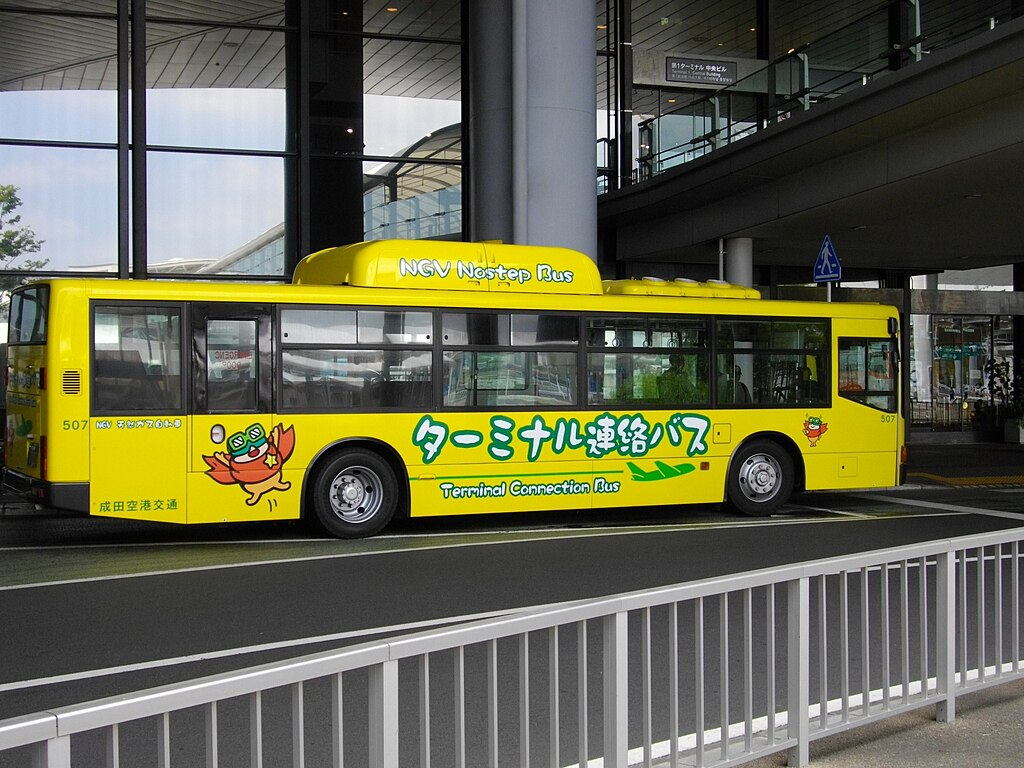
A free shuttle service connects all terminals. It runs roughly every 10 minutes in a circular route, taking 14 minutes to complete a journey from T1 to T3 (stopping at T2).
There’s also a signed pedestrian walkway between T2 and T3, which takes about 15 minutes.
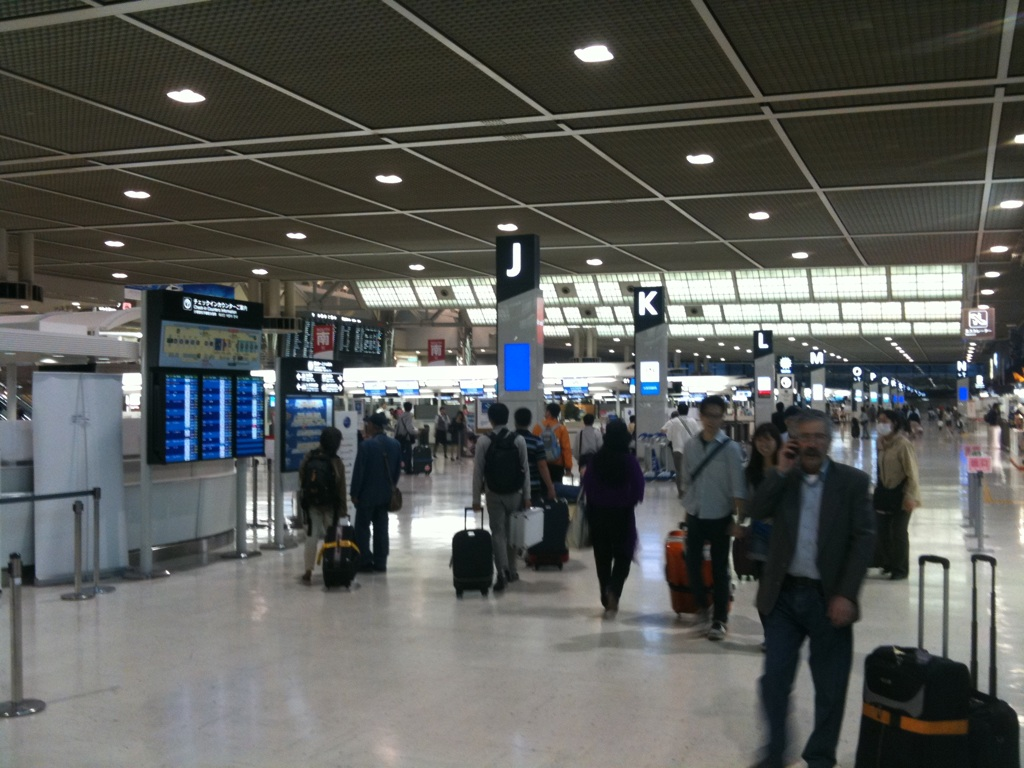
Despite Narita’s massive size, the airport is organized conveniently, and moving around is efficient. There are rarely queues at Security before departure, although lines sometimes form before Immigration on arrival.

Connecting Flights and Transit at Narita
Narita’s terminals are well-connected, with free shuttle buses running between all three terminal buildings every 5 to 7 minutes during operating hours of the airport (6 AM to midnight). Crossing between T2 and T3 is even easier on foot via the access corridor.
Narita authorities recommend at least 90 minutes for same-terminal transfers, longer if changing terminals. Transfers within the same terminal are quite smooth thanks to clear signage in Japanese and English. If you’re in Terminal 1, keep in mind walking distances can be large anyway - up to 15 minutes to the farthest gates.
The three terminals are NOT connected airside. If you want to change terminals, you must clear Immigration and Security and proceed to your new terminal, then pass through Security and Immigration again.
Connections within the same terminals are easy. Just find your new gate! You may remain within the transit area (airside) until your next flight.
Note that you cannot remain in the passenger terminals on the airside overnight (between midnight and 5 AM). The airport closes and with it all facilities, lounges, and waiting areas. If you have a connecting flight the next day, you must go landside to wait. You may need a visa to do so.
WiFi at Narita Airport
Narita provides free, unlimited WiFi across all public and departure areas.
To connect, select “FreeWiFi-NARITA” from the list of available networks, and agree to the terms and conditions on the splash page that should open automatically. No registration is required.
If you’re going to explore Japan, you can rent pocket Wi-Fi or buy SIMs/eSIMs from various carriers in Terminals 1 and 2.
Dining Options
Each terminal offers a range of dining venues.
Terminals 1 and 2 provide both sit-down and fast-food options, including Japanese favorites (ramen, sushi, soba, and others) and international selections.
Some favorite places to eat in T1 include:
Fujiya Restaurant for western cuisine, located on the fifth floor.
Ippudo for ramen and other noodle dishes, located on the third floor.
Kawatoyo for Japanese cuisine on floor 4.
Komeraku for Japanese specialties with rice and fish near Gate 10 on the third floor.
Caffe Lat.25 on the first floor, Doutor coffee shop on 3F, and several other cafes for the wake-me-up drink.
Similarly, in Terminal 2, the following places are worth checking out:
Ginza Kagari for ramen and other noodles on 2F.
Gyukatsu Kyoto Katsugyu for Japanese cuisine with a focus on katsu dishes on 2F.
Mitsumoto Tei for Western cuisine on the second floor.
Tsukiji Sushiko for sushi on the fourth floor, before Security.
Dean & Deluca coffee on the third floor after Security, among other cafes like Starbucks, Doutor coffee shop, and FaSoLa cafe, with options both airside and landside.
Terminal 3 features a large budget-friendly food court focused on quick, inexpensive meals. Options include Hakata Ittenmon, Matsuya, Botejyu Express, and Miyatake Sanudi Udon, all serving different Japanese cuisine staples.
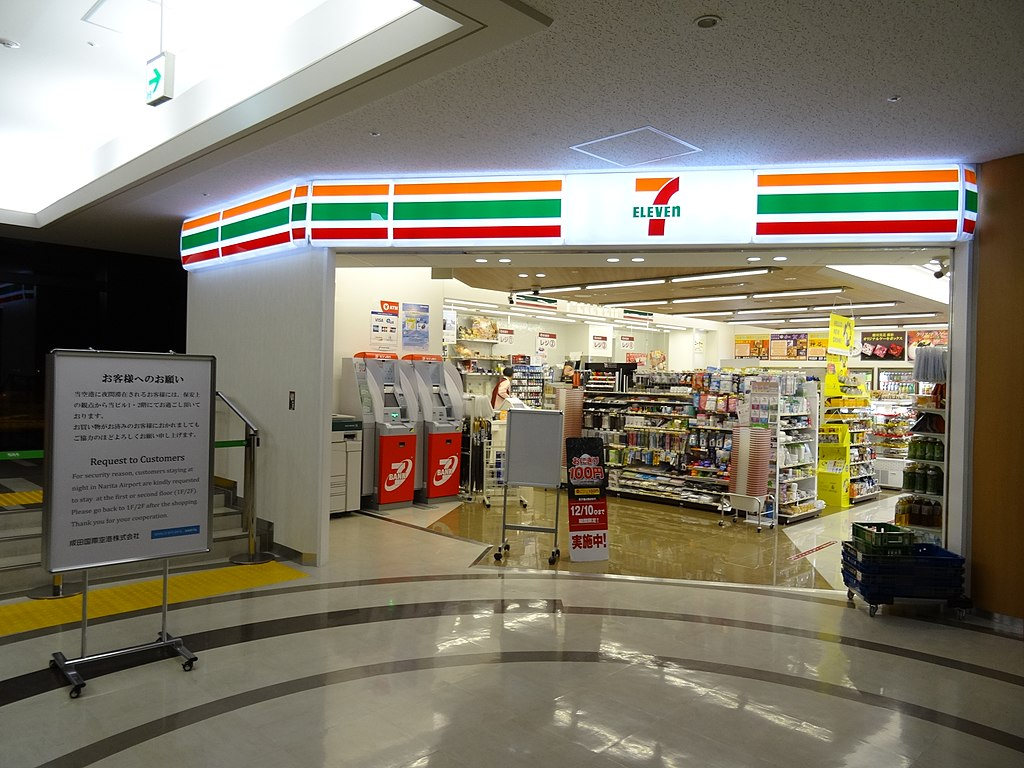
Convenience stores (offering bento boxes, snacks, drinks, and travel essentials) can be found throughout all terminals, handy for last-minute grabs or stocking up stacks for the flight.
Vending machines for drinks or ice cream can also be found in many areas of the airport, with prices not much higher than in the city.
Lounges
Several lounges are available in Terminals 1 and 2 of NRT.
Airline-specific lounges include:
Terminal 1:
4 ANA lounges, including the premium ANA Suite Lounge on the fourth floor.
Korean Air Lounge (3F), United Club (3F), and Turkish Airlines Lounge (4F), all after Security.
The independent Narita Premier Lounge, located on the fourth floor after Security.
Terminal 2:
2 JAL Sakura Lounges and the airline’s First Class Lounge.
Dynasty Lounge by China Airlines, First and Business Class Lounge by Cathay Airways, and the Emirates Lounge.
The independent Aspire Lounge, which offers facilities to all travelers for a fee.
Lounges across terminals typically provide showers and meal options, with access rules tied to class or frequent-flyer status, although several are open to all travelers for a fee.
The International Airport Service Systems (IASS) also operates four lounges at Narita Airport - two in each of Terminals 1 and 2. These are open to various credit card holders.
Terminal 3 has no lounges.
Transport from Narita Airport to Tokyo
Despite being quite far from central Tokyo (around 70-80 km), Narita is well served by public transport.
The Narita Express (N’EX) takes about 50-60 minutes to Tokyo Station and runs through to Shinjuku, Shibuya, and Yokohama. Ticket prices depend on the type of carriage: ¥3,020 for ordinary cars and ¥4,560 for Green Cars (the equivalent of Business class).

The Keisei Skyliner is faster to Ueno and Nippori. It takes 36 minutes, costing ¥2,520, with easy transfers to the JR Yamanote line and other public transport options from Ueno.
Budget travelers might choose Keisei’s Access Express or Rapid trains, which use the same line but are significantly slower (up to 85 minutes between Ueno and Narita), but also cost a lot less, as little as ¥1080.

Another option for those on a budget is the TYO-NRT bus, which serves central Tokyo for a flat fare of ¥1500 for adults (half for kids). The journey time is 90-120 minutes.
Airport limousine buses run to major Tokyo hotels and hubs. Inquire with your hotel to check if this is an option. Click here to see more information about private transfers.
Taxis are available but expensive (often more than ¥20,000) due to the distance and tolls, making them a last-resort option. They are never faster than the Narita Express or the Skyliner, so they very rarely make economic sense, unless you’re looking for a truly private ride.
Car Rental companies are available at T1 and T2. You should check carefully if your international licence is considered valid in Japan, because of the strict laws and limited acceptance.

Transport between Narita and Haneda Airports
As the two primary airports serving the Tokyo agglomeration, it is not that rare to land at one of them and have a departing flight from the other. The two airports are around 1.5-2 hours apart by rail or bus.
To get from Narita to Haneda (or vice versa), the Keisei Electric Railway stands out as the best option with its direct train service between the two airports, taking just 101 minutes.
Other connection options include changing trains at Tokyo Station to take the Haneda Express. There are also direct buses.
Parking at Tokyo Narita Airport
Narita offers parking lots adjacent to Terminals 1 and 2. If you use Terminal 3, the closest car parks are those serving Terminal 2.
P1 and P5 serve Terminal 1, while P2 (split into P2-S, P2-N, P2-NA, and P2-NB) and P3 serve Terminal 2. P2 also connects to Terminal 3.
Daily rates range from around ¥1,570 (P5 for up to 24 h) to ¥2,360 (P2 for up to 24 h), with progressively higher charges for extended stays.
Pricing scales with exact hours used, and reservations include a ¥1,400 booking fee. Discounts are available for disabled drivers.
Long-term parking adds approximately ¥1,000 per day after the initial period.
Hotels at or near Narita Airport
Narita has convenient lodging for layovers and early flights.
Terminal 2 has the Nine Hours Narita Airport capsule hotel, located landside, making it perfect for layover stays and very early flights. It features a 24-hour reception and basic amenities, although in Japan, that’s often more than what you might expect. Still, do note that “rooms” are effectively capsules in a shared alley with shared bathrooms and showers.
The rates are ¥1500 for the first hour plus ¥500 for each hour thereafter. Showers are free for staying guests, but available to non-guests too, at a price of ¥1000 for an hour.
For standard hotels, chains like Hilton, Marriott, and Crowne Plaza provide shuttles from their properties outside the airport grounds to the terminals.
Local brands with hotels near Narita Airport include Narita Tobu Hotel Airport, Toyoko Inn Narita Airport Shinkan, and Marroad International Hotel Narita.
See a comprehensive list of available airport hotels near NRT here.
 Tokyo, Japan